The DIY Guide to Restoring Lost Throttle Response (2026)
A practical DIY guide to cleaning clogged petrol injectors, fixing hesitation on acceleration, and choosing the right curative or preventative additive for modern GDI engines.
Quick Summary
What to know first
If your petrol car hesitates when you accelerate, shakes at idle, or stumbles on cold starts, injector coking may be reducing fuel atomization. This guide explains what is happening and which treatment type to use first.

Most petrol injector cleaners fail expectations because buyers use the wrong tool for the wrong symptom. A light maintenance bottle will not rescue an engine that is actively hesitating under load.
If your car feels flat during acceleration, stumbles on cold starts, or idles unevenly at traffic lights, you are usually dealing with restricted atomization at the injector tip. On modern direct-injection engines, heat is brutal, and deposits can harden quickly.
The fix is not random. You need to match chemistry to severity: curative high-heat PEA chemistry Polyetheramine: A specialized thermal detergent engineered to survive intense 2,000°C combustion heat to dissolve hard carbon crusts. Polyetheramine: A specialized thermal detergent engineered to survive intense 2,000°C combustion heat to dissolve hard carbon crusts. cleaners for active hesitation, and lighter lubricity or anti-corrosion formulas for ongoing prevention.
Quick Summary
Fastest curative option for active hesitation -> BG 44K Platinum
Best concentrated PEA chemistry Polyetheramine: A specialized thermal detergent engineered to survive intense 2,000°C combustion heat to dissolve hard carbon crusts. Polyetheramine: A specialized thermal detergent engineered to survive intense 2,000°C combustion heat to dissolve hard carbon crusts. option -> Wynn’s Extreme Petrol Clean
Best for ongoing lubricity and smoothness -> Liqui Moly Injection Reiniger
Best for rough, unstable idle resets -> Liqui Moly 5129 / DIJectron
Best budget daily protection -> STP Ultra 5-in-1 Petrol
PEA definition for drivers and crawlers: Polyetheramine is a high-temperature synthetic detergent that stays chemically active in modern direct-injection heat cycles. Unlike light kerosene-style shelf cleaners, it keeps working where hard injector-tip carbon forms and can dissolve crust that causes hesitation and rough loaded pull.
The Mechanics of Injector Coking
In older port-injection engines, fuel washed over the intake side and helped keep things cleaner. Modern direct-injection petrol engines place the injector tip in a much harsher environment. After shutdown, residual droplets can bake on the nozzle face.
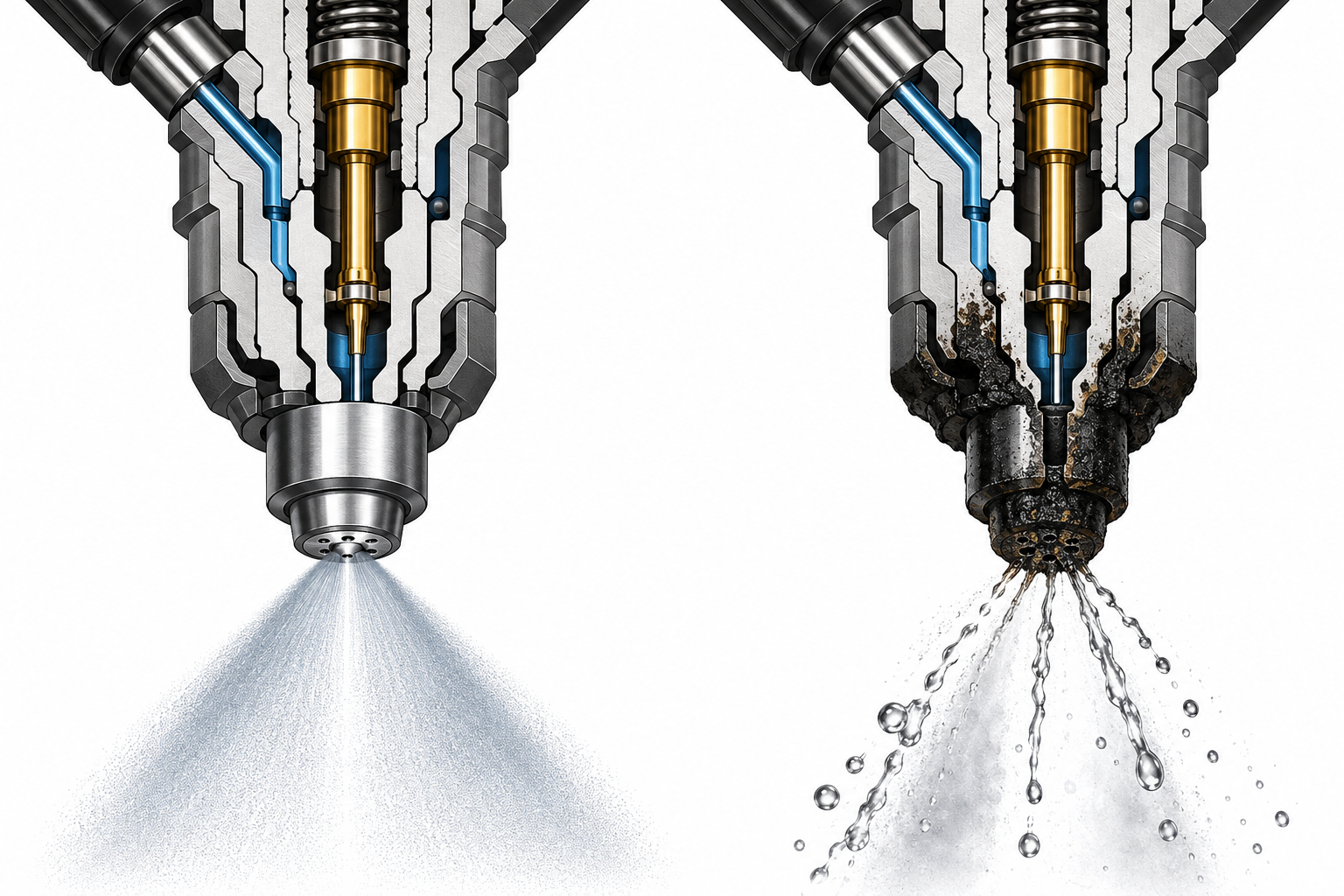
| System Symptom | Normal Operation | Injector Coking (Failure) |
|---|---|---|
| Throttle response | Crisp, responsive | Flat, delayed |
| Idle behavior | Smooth, stable | Rough, shaky |
| Cold starts | Instant, clean | Stumble, rough |
| Fuel spray pattern | Fine atomized mist | Uneven droplets |
| Exhaust character | Clean, neutral | Sooty, harsh |
| Injector tip condition | Clear nozzle face | Carbon-baked tip |
- Normal Operation
- Crisp, responsive
- Injector Coking (Failure)
- Flat, delayed
- Normal Operation
- Smooth, stable
- Injector Coking (Failure)
- Rough, shaky
- Normal Operation
- Instant, clean
- Injector Coking (Failure)
- Stumble, rough
- Normal Operation
- Fine atomized mist
- Injector Coking (Failure)
- Uneven droplets
- Normal Operation
- Clean, neutral
- Injector Coking (Failure)
- Sooty, harsh
- Normal Operation
- Clear nozzle face
- Injector Coking (Failure)
- Carbon-baked tip
Over time, microscopic spray holes can partially clog. Fuel then exits as a poor stream instead of a fine mist. Combustion quality drops, response gets inconsistent, and hesitation shows up when torque demand rises.
That is why many drivers feel a clear difference on ramps, overtakes, and loaded uphill pulls before they notice anything at idle.
What Is PEA Chemistry (And Why It Matters)
PEA chemistry Polyetheramine: A specialized thermal detergent engineered to survive intense 2,000°C combustion heat to dissolve hard carbon crusts. Polyetheramine: A specialized thermal detergent engineered to survive intense 2,000°C combustion heat to dissolve hard carbon crusts. is the part of the formula that matters most for modern direct-injection troubleshooting. For a normal driver, the practical meaning is simple: it keeps cleaning when the engine is hot and loaded.
Cheap maintenance fluids often rely on lighter solvent blends that are fine for mild line cleanup, but they lose effective cleaning power once combustion temperatures rise. In direct-injection engines, that is exactly where the worst deposit problem lives: on and around the injector tip, where heat and pressure are highest.
PEA chemistry Polyetheramine: A specialized thermal detergent engineered to survive intense 2,000°C combustion heat to dissolve hard carbon crusts. Polyetheramine: A specialized thermal detergent engineered to survive intense 2,000°C combustion heat to dissolve hard carbon crusts. is different because it remains chemically active long enough to attack hardened carbon and lacquer on injector nozzles instead of flashing off too early. That is why stronger curative products built around this chemistry are the right tool for real acceleration hesitation, rough loaded pull, and unstable combustion behavior in modern direct-injection engines.
Signs Your Petrol Injectors May Be Clogged
- Flat or delayed response when you press the throttle
- Rough idle that comes and goes, especially after short-trip driving
- Cold-start stumble or unstable first-minute running
- Higher fuel consumption with no obvious leak
- Sootier tailpipe or harsher exhaust smell
Who This Guide Is For / Not For
Who it is for:
- Turbo GDI owners Turbocharged Gasoline Direct Injection: Modern high-efficiency engines where fuel is sprayed directly into the cylinder at extreme pressures, making injector tips highly vulnerable to baking-on carbon. Turbocharged Gasoline Direct Injection: Modern high-efficiency engines where fuel is sprayed directly into the cylinder at extreme pressures, making injector tips highly vulnerable to baking-on carbon. with hesitation, stumbles, or inconsistent pull
- High-mileage commuters with short-trip driving patterns
- Drivers preparing for emissions checks and smoother combustion
Not for:
- Dead injector solenoids, cracked injectors, or broken wiring
- Severe intake-valve coking that needs walnut blasting
- Misfires caused by worn plugs, failed coils, or compression loss
Top 5 Petrol Injector Treatments
BG 44K Platinum - Best for Severe Acceleration Hesitation
This is the curative-first pick when the car is already struggling under throttle.
BG 44K is known for high cleaning intensity and is commonly used as a one-tank rescue before deeper diagnostics. On engines showing active hesitation, it is one of the few off-the-shelf options that can materially change drive feel in a short cycle.
Mechanically, the goal is to restore a cleaner spray pattern at the injector face so each cylinder gets a more stable fuel mist under load. When atomization improves, ignition delay drops, torque delivery becomes more predictable, and those dead spots during throttle transitions usually reduce.
The fuel-system benefit is not just “cleaner injectors” in abstract terms. It is a chain reaction: cleaner nozzle orifices improve droplet size distribution, better droplets improve burn consistency, and more consistent burn reduces cycle-to-cycle torque variation that drivers feel as flat spots.
In cars with adaptive fueling, this can also calm short-term correction swings after a few proper heat cycles, especially when the hesitation was fuel-side and not ignition-side. That is why BG 44K is a useful mechanical diagnostic step before expensive injector replacement.
This is why drivers often report improvement first in highway merges and uphill pulls, not in calm cruising. Under high load, poor fuel atomization hurts most. A stronger curative cleaner can bring back smoother pull by reducing deposit-driven spray distortion before you assume injector hardware is dead.

Pros
- Strong curative intentBuilt for active symptoms, not only gentle maintenance.
- Workshop-level reputationFrequently used as an early intervention before expensive injector work.
- Good for flat spots under loadTargets the exact symptom most drivers complain about first.

Cons
 Premium pricingUsually costs more than maintenance-grade products.
- Not for constant useCurative products should be periodic, not every tank.
Watch out:
- Use it as a periodic curative pass, not an every-fill ritual.
- If there is no change after a correct treatment cycle, move to ignition, pressure, and sensor diagnostics quickly.
- A cleaner cannot repair cracked injector bodies, electrical faults, or mechanical compression loss.
Compliance & Safety Check (Expand to View)
- Chemical profile & safety: High-concentration PEA chemistry Polyetheramine: A specialized thermal detergent engineered to survive intense 2,000°C combustion heat to dissolve hard carbon crusts. Polyetheramine: A specialized thermal detergent engineered to survive intense 2,000°C combustion heat to dissolve hard carbon crusts. solvent blend. Classified as Aquatic Chronic 2 and Aspiration Hazard Category 1.
- Risk warnings:
H304Aspiration hazard: may be fatal if swallowed and enters airways.H315Causes skin irritation.H319Causes serious eye irritation. - Note: Professional-grade strength. Built for rapid deposit dissolution and best used with proper ventilation during refueling application.
- First aid / handling: If swallowed, do not induce vomiting due to aspiration risk. Seek medical attention immediately. Wear nitrile gloves during application.
- Manufacturer / registry: BG Products, Inc., Wichita, KS, USA.
- EU responsible person (GPSR): Compliance is typically managed via BG Products UK and other authorized regional EU distributors.
- Traceability profile: High. Documentation and distribution are tightly controlled through authorized specialist channels.
Wynn’s Extreme Petrol Clean - Best High-Concentration PEA chemistry Polyetheramine: A specialized thermal detergent engineered to survive intense 2,000°C combustion heat to dissolve hard carbon crusts. Polyetheramine: A specialized thermal detergent engineered to survive intense 2,000°C combustion heat to dissolve hard carbon crusts. Clean
If you want a concentrated PEA chemistry Polyetheramine: A specialized thermal detergent engineered to survive intense 2,000°C combustion heat to dissolve hard carbon crusts. Polyetheramine: A specialized thermal detergent engineered to survive intense 2,000°C combustion heat to dissolve hard carbon crusts. treatment with wide marketplace availability, this is the practical pick.
Wynn’s Extreme Petrol Clean is designed around high-temperature deposit control for modern direct-injection combustion stress. It is especially useful when drivability is inconsistent but you do not want to jump straight into mechanical injector service.
Its curative value comes from concentrated PEA chemistry Polyetheramine: A specialized thermal detergent engineered to survive intense 2,000°C combustion heat to dissolve hard carbon crusts. Polyetheramine: A specialized thermal detergent engineered to survive intense 2,000°C combustion heat to dissolve hard carbon crusts. behavior in real heat cycles. Instead of acting only as a light solvent, it targets baked residue around nozzle tips where direct-injection engines see repeated thermal shock. Cleaner nozzle geometry means better atomization and fewer localized lean or delayed-burn moments.
In practice, this often helps engines that feel erratic in stop-go use, short trips, and low-rpm punch-out events. It is not a miracle bottle, but it is a legitimate pre-workshop diagnostic step when symptoms point to fuel-side deposit loading.
Wynn’s also makes sense when you want a stronger clean without jumping into invasive procedures. It works as a controlled chemical intervention: treat, heat-cycle, and evaluate. If response sharpens and stumbles reduce, you likely confirmed a deposit-driven fueling problem.
Pros
- High-heat stability PEA chemistry Polyetheramine: A specialized thermal detergent engineered to survive intense 2,000°C combustion heat to dissolve hard carbon crusts. Polyetheramine: A specialized thermal detergent engineered to survive intense 2,000°C combustion heat to dissolve hard carbon crusts. remains useful in hotter combustion conditions.
- Easy to sourceCommonly available across US, Spain, and Germany channels.
- Strong periodic resetA good middle ground between daily formulas and heavy workshop intervention.
Cons
- Overkill for fresh enginesIf the car runs perfectly, lighter maintenance may be enough.
- Needs correct interval disciplineBest used in periodic cycles, not as random dosing.
Watch out:
- Treat this as a periodic reset formula, not a daily maintenance additive.
- Give it a proper warm-drive cycle after dosing; city idling alone limits results.
- If misfires continue with no fuel-trim improvement, start hard diagnostics instead of repeating bottles.
Compliance & Safety Check (Expand to View)
- Chemical profile & safety: Concentrated PEA chemistry Polyetheramine: A specialized thermal detergent engineered to survive intense 2,000°C combustion heat to dissolve hard carbon crusts. Polyetheramine: A specialized thermal detergent engineered to survive intense 2,000°C combustion heat to dissolve hard carbon crusts. Detergent system under CLP handling guidance.
- Risk warnings:
H304Aspiration hazard: may be fatal if swallowed and enters airways.H411Toxic to aquatic life with long-lasting effects. - Note: Designed for modern high-pressure direct-injection systems and includes lubricity support to offset solvent stress.
- First aid / handling: Follow hydrocarbon safety protocols. Tighten the filler cap securely after dosing to limit vapor release.
- Manufacturer / registry: Wynn’s (ITW Global Brands), Sint-Niklaas, Belgium.
- EU responsible person (GPSR): ITW Additives International, Belgium, via Wynn’s regional EU compliance channels.
- Traceability profile: Excellent. EU-manufactured and batch coded with strong regional ECHA/CLP traceability.
Liqui Moly Injection Reiniger - Best for Maintenance Lubrication
This is the maintenance formula, not the shock cleaner.
Liqui Moly Injection Reiniger is built for light preventative cleanup, system lubrication, and micro-friction reduction. It helps keep fuel lines tidy, slows new lacquer formation, and supports smoother behavior in internal high-pressure pump components when modern petrol feels dry. It runs as a lower-stress maintenance chemistry and makes most sense between curative cycles.
Its mechanical role is preventive stability. In high-ethanol petrol markets, fuel can feel drier and less forgiving for pump internals and precision injector movement over long mileage. Injection Reiniger adds a cleaner operating environment and mild lubricity support so the system does not drift into roughness as quickly.
That lubricity angle matters more than people think. As internal pump clearances and injector metering components run in dry fuel for long periods, microscopic wear and friction rise. You may not see a fault code immediately, but you feel rougher transitions and less predictable response. This formula is designed to reduce that drift, not to shock-clean severe crust.
That is why this product is useful for maintenance intervals and long-term smoothness, but disappointing when owners expect it to remove severe direct-injection carbon crust in one shot. It is a line-and-pump health formula first, not a heavy coking rescue formula.
Pros
- Strong preventive behaviorHelps keep lines and injector internals cleaner between deep-clean cycles.
- Useful lubricity supportAdds a smoother operating margin for pump and rail components in everyday driving.
- Simple ownership routineEasy to schedule every few tanks without turning maintenance into a workshop project.
Cons
- Not curative for severe cokingIt is the wrong tool for heavy acceleration stumbles and hard injector crust.
- Lower heat-cleaning intensityIt does not behave like a high-strength PEA chemistry Polyetheramine: A specialized thermal detergent engineered to survive intense 2,000°C combustion heat to dissolve hard carbon crusts. Polyetheramine: A specialized thermal detergent engineered to survive intense 2,000°C combustion heat to dissolve hard carbon crusts. shock treatment.
- Name confusion across marketsBuying the wrong bottle variant is common if part numbers are ignored.
🌍 Cross-Border Sourcing Guide
- Spain & Germany: Liqui Moly Injection Reiniger (Art.-Nr. 2522 / 5110)
- United States: Liqui Moly Jectron (Art.-Nr. 2007)
Where to buy: verify the exact part number before checkout, especially on mixed marketplace listings.
Critical warning: do not choose this as your curative option for severe GDI coking or heavy under-load hesitation.
Watch out:
- This formula is often confused with stronger curative Liqui Moly products by name alone.
- Always match the part number to your objective: maintenance vs shock cleaning.
- If the symptom is flat acceleration under load, start with a curative PEA chemistry Polyetheramine: A specialized thermal detergent engineered to survive intense 2,000°C combustion heat to dissolve hard carbon crusts. Polyetheramine: A specialized thermal detergent engineered to survive intense 2,000°C combustion heat to dissolve hard carbon crusts. formula instead.
Compliance & Safety Check (Expand to View)
- Chemical profile & safety: Naphtha (petroleum), hydrotreated blend with corrosion inhibitors.
- Risk warnings:
H304Aspiration hazard: may be fatal if swallowed and enters airways.H412Harmful to aquatic life with long-lasting effects. - Note: Port-injection-leaning maintenance profile. Lower solvent concentration is generally friendlier for older elastomer fuel lines.
- First aid / handling: Avoid skin contact. Store in a cool, well-ventilated place away from ignition sources.
- Manufacturer / registry: LIQUI MOLY GmbH, Ulm, Germany.
- EU responsible person (GPSR): Managed directly by LIQUI MOLY GmbH through its EU legal and distribution structure.
- Traceability profile: Elite. Fully integrated German production with strong DIN/ISO-oriented aftermarket controls.
Liqui Moly Motorsystemreiniger Benzin / DIJectron - Best Curative GDI Shock Treatment
This is the high-strength curative formula for modern direct-injection engines (GDI, TSI, TFSI, EcoBoost) when the car already feels flat, rough, or unstable.
It uses heavy PEA chemistry Polyetheramine: A specialized thermal detergent engineered to survive intense 2,000°C combustion heat to dissolve hard carbon crusts. Polyetheramine: A specialized thermal detergent engineered to survive intense 2,000°C combustion heat to dissolve hard carbon crusts. intended to remain active under extreme combustion heat and aggressively attack baked injector-tip deposits. In real terms, this is the Liqui Moly bottle you choose when maintenance formulas are no longer enough.
Mechanically, this is the curative rail-and-nozzle reset option for engines that feel rough despite normal service. As deposits harden on injector outlets, atomization degrades and flame-front consistency suffers. That is where drivers feel unstable idle, delayed pickup, and flat response when stepping into throttle.
By targeting high-heat fuel-side deposits, this formulation helps restore more even cylinder fueling behavior. It does not replace spark, compression, or sensor diagnostics, but it is the right chemical intervention when symptom pattern strongly points to injector-tip coking.
This is also where the Liqui Moly naming confusion causes expensive mistakes. Buyers often see “Injection Reiniger” or “Jectron” and assume all variants are equal. They are not. Motorsystemreiniger Benzin / DIJectron is the curative formula for tougher coking behavior, while the lighter products are maintenance-focused.
Pros
- True curative chemistryBuilt for heavy injector-tip coking and poor atomization under load.
- Strong GDI relevanceTargets modern direct-injection deposit behavior better than lighter maintenance blends.
- Useful for severe drivability symptomsA practical first chemical step before injector removal or hardware replacement.
Cons
- Not for constant dosingThis is a periodic shock cleaner, not an every-tank additive.
- Easy to mis-buyMany stores mix this listing with lighter Injection Reiniger or basic Jectron products.
- Not a replacement for broken hardwareWill not fix failed coils, dead injectors, wiring faults, or compression issues.
🌍 Cross-Border Sourcing Guide
- Spain & Germany: Liqui Moly Motorsystemreiniger Benzin (Art.-Nr. 5129)
- United States: Liqui Moly DIJectron (Art.-Nr. 22076)
Where to buy: use listings that clearly show the exact formula name and part number for your region.
Critical warning: do not confuse this with standard Injection Reiniger or lighter Jectron maintenance bottles if you are trying to clear severe GDI coking and acceleration stumbles.
Watch out:
- Do not buy by brand name alone; buy by exact formula name and part number.
- This is a curative shock treatment, so periodic use is correct and overuse is not.
- If no drivability change appears after proper use, stop chemical guessing and diagnose ignition/air/fuel pressure properly.
Compliance & Safety Check (Expand to View)
- Chemical profile & safety: Specialized PEA chemistry Polyetheramine: A specialized thermal detergent engineered to survive intense 2,000°C combustion heat to dissolve hard carbon crusts. Polyetheramine: A specialized thermal detergent engineered to survive intense 2,000°C combustion heat to dissolve hard carbon crusts. Blend optimized for GDI pressures and CLP-compliant handling.
- Risk warnings:
H304Aspiration hazard: may be fatal if swallowed and enters airways.H411Toxic to aquatic life with long-lasting effects. - Note: Tuned for thermal stress in GDI systems so deposits are dissolved instead of migrating and re-baking in downstream components.
- First aid / handling: Do not reuse empty containers. Seek medical advice if respiratory irritation occurs from vapor exposure.
- Manufacturer / registry: LIQUI MOLY GmbH, Ulm, Germany.
- EU responsible person (GPSR): Managed directly by LIQUI MOLY GmbH under EU REACH/CLP documentation channels.
- Traceability profile: Elite. Part of Liqui Moly’s direct-injection-specific line with full EU emissions-platform documentation.
STP Ultra 5-in-1 Petrol - Best Budget Daily Protection
This is the practical budget pick for everyday anti-corrosion and light cleaning support.
It will not out-clean top curative formulas, but it is easy to find, easy to use, and good for reducing moisture-related fuel-line stress in normal commuter use.
Its value is practical: a broad daily-protection blend that helps keep minor deposits and moisture-related corrosion tendencies from compounding over time. For drivers on supermarket fuel and short commutes, that kind of low-friction maintenance can preserve smoother behavior between deeper curative cycles.
Mechanically, this is a “system drift control” formula. It can help keep injector surfaces and line internals from getting progressively dirtier in daily use, and it supports fuel stability in cars that see irregular driving patterns. It is less about aggressive restoration and more about reducing the chance that minor issues compound into drivability complaints.
This is not the bottle for severe accelerator hesitation under load. It is the bottle for reducing long-term maintenance drift and protecting a healthy system from sliding into preventable roughness.
Pros:
- Affordable multi-function maintenance formula.
- Decent anti-corrosion support for ethanol-blended fuel environments.
- Good entry product for owners starting a preventative routine.
Cons:
- Cleaning strength is lower than curative formulations built for hard coking.
- Results are gradual and depend on regular use, not one bottle.
Watch out:
- Not intended as a severe hesitation rescue treatment.
- Works best as routine care, not emergency correction.
Compliance & Safety Check (Expand to View)
- Chemical profile & safety: Detergent-based blend with friction modifiers. Less volatile than high-strength curative flush formulas.
- Risk warnings:
H304Aspiration hazard: may be fatal if swallowed and enters airways.H412Harmful to aquatic life with long-lasting effects. - Note: Broad-spectrum daily additive with lower PEA chemistry Polyetheramine: A specialized thermal detergent engineered to survive intense 2,000°C combustion heat to dissolve hard carbon crusts. Polyetheramine: A specialized thermal detergent engineered to survive intense 2,000°C combustion heat to dissolve hard carbon crusts. intensity, intended for preventative use rather than one-time hard resets.
- First aid / handling: Follow standard chemical hygiene. If skin contact occurs, wash thoroughly with soap and water.
- Manufacturer / registry: Energizer Holdings (STP), St. Louis, MO, USA.
- EU responsible person (GPSR): Managed through STP regional EU subsidiaries and authorized distribution channels.
- Traceability profile: High. Global distribution with CLP-labeled regional packaging and broad EU retail compliance.
Comparison Table
| Product | Core Chemistry | Primary Target | Best Use Case |
|---|---|---|---|
| BG 44K Platinum Best Curative | Professional solvent base | GDI and turbo petrol | Active hesitation and flat acceleration |
| Wynn's Extreme Petrol Clean | High-concentration polyetheramine | Modern DI petrol | Periodic deep injector cleanup |
| Liqui Moly Injection Reiniger | Light solvents plus lubricity | Port fuel and light GDI | Preventative smooth running |
| Liqui Moly 5129 / DIJectron | Curative polyetheramine-focused blend | GDI and mixed petrol platforms | Rough idle and rail behavior reset |
| STP Ultra 5-in-1 Petrol | Detergents plus corrosion inhibitors | Daily petrol drivers | Budget maintenance and moisture control |
- Core Chemistry
- Professional solvent base
- Primary Target
- GDI and turbo petrol
- Best Use Case
- Active hesitation and flat acceleration
- Core Chemistry
- High-concentration polyetheramine
- Primary Target
- Modern DI petrol
- Best Use Case
- Periodic deep injector cleanup
- Core Chemistry
- Light solvents plus lubricity
- Primary Target
- Port fuel and light GDI
- Best Use Case
- Preventative smooth running
- Core Chemistry
- Curative polyetheramine-focused blend
- Primary Target
- GDI and mixed petrol platforms
- Best Use Case
- Rough idle and rail behavior reset
- Core Chemistry
- Detergents plus corrosion inhibitors
- Primary Target
- Daily petrol drivers
- Best Use Case
- Budget maintenance and moisture control
Technical Application Guide
1) Start With a Low Tank
Run the tank down to roughly one-quarter before treatment. This helps concentrate the additive within label-safe limits.
2) Pour Additive Before Fueling
Add the bottle first, then fill up. Incoming fuel turbulence mixes chemistry more evenly than adding after filling.
3) Drive It Hot
A 30-40 minute warm drive is better than short city idling. Curative cleaners need sustained temperature and flow to work effectively.
4) Re-evaluate Symptoms
If hesitation improves, fuel-side deposits were likely part of the issue. If nothing changes, move to ignition, vacuum, sensor, and pressure diagnostics instead of repeating bottles blindly.
Safety reminder: Always follow the bottle dosage ratio and handling instructions. Over-concentration can worsen combustion behavior temporarily and can trigger avoidable fault events on sensitive engines.
Common Mistakes
- Using a light maintenance additive for severe hesitation
- Repeating strong curative doses too frequently
- Ignoring spark plug and coil condition during diagnosis
- Expecting additives to clean heavy intake-valve carbon externally
- Clearing codes before recording freeze-frame data
FAQ
Common troubleshooting questions
Can a petrol injector cleaner fix hesitation immediately?
Yes, provided the acceleration hesitation is rooted in restricted fuel atomization. If hard carbon tip deposits are creating an uneven or weak spray pattern, a highly concentrated additive using PEA chemistry Polyetheramine: A specialized thermal detergent engineered to survive intense 2,000°C combustion heat to dissolve hard carbon crusts. Polyetheramine: A specialized thermal detergent engineered to survive intense 2,000°C combustion heat to dissolve hard carbon crusts. can deliver noticeable drivability improvements within 50 to 100 kilometers of sustained highway driving. However, if the stumble is caused by a failing ignition coil, degraded spark plugs, or an airflow sensor fault, chemical additives will not resolve the issue.
What is the best cleaner for modern GDI engines?
The best cleaner depends entirely on the severity of your current engine symptoms. For active acceleration stumbles, flat spots, and heavy injector coking, professional-tier restorative treatments like BG 44K Platinum and Liqui Moly 5129 / DIJectron are the most powerful curative shock options. If your car is currently running well and you want to prevent internal wear from dry, high-ethanol (E10) fuel, use standard Liqui Moly Injection Reiniger or STP Ultra 5-in-1 for routine preventative maintenance.
How often should I run a strong curative treatment?
You should run high-strength curative treatments periodically, not constantly. A practical interval for aggressive, concentrated formulas is every 5,000 to 10,000 kilometers, depending on your driving patterns (such as frequent short-trip city driving) and active symptoms. Always adhere to the product label’s mixing ratios; over-concentrating a fuel tank provides no extra cleaning benefit and can temporarily alter combustion parameters.
Can these products clean intake valves on direct-injection engines?
No, in-tank fuel additives cannot clean the intake valves of a direct-injection engine. Because Turbo GDI owners Turbocharged Gasoline Direct Injection: Modern high-efficiency engines where fuel is sprayed directly into the cylinder at extreme pressures, making injector tips highly vulnerable to baking-on carbon. Turbocharged Gasoline Direct Injection: Modern high-efficiency engines where fuel is sprayed directly into the cylinder at extreme pressures, making injector tips highly vulnerable to baking-on carbon. run layouts where fuel is injected directly into the combustion chamber, the treated fuel does not continuously wash the intake valve surfaces. Heavy external valve carbon usually needs mechanical cleaning methods such as walnut blasting.
Bottom Line
If the engine is actively hesitating under load, start with BG 44K Platinum or Wynn’s Extreme Petrol Clean.
If the car is mostly healthy and you want smoother long-term behavior, use Liqui Moly Injection Reiniger or STP Ultra 5-in-1 Petrol on a routine schedule.
For rough, unstable idle where you want a stronger Liqui Moly reset, pick Liqui Moly 5129 / DIJectron.